


When you got the call, the one you always feared but hoped would never come, your world tilted. Your twenty‑year‑old daughter—or son—was using again. The silence in the kitchen felt louder. The late‑night drives made you hold your breath. Between hope and helplessness you wondered: What now?
At Ascend North Carolina, we know parents exactly in this spot. And one truth we’ve seen quietly but powerfully clear is this: when family involvement shows up, alcohol addiction treatment works better.
This isn’t about blame, control, or perfection. It’s about presence. It’s about turning fear into action. Let’s walk through what that means.
Why family involvement matters in alcohol addiction treatment
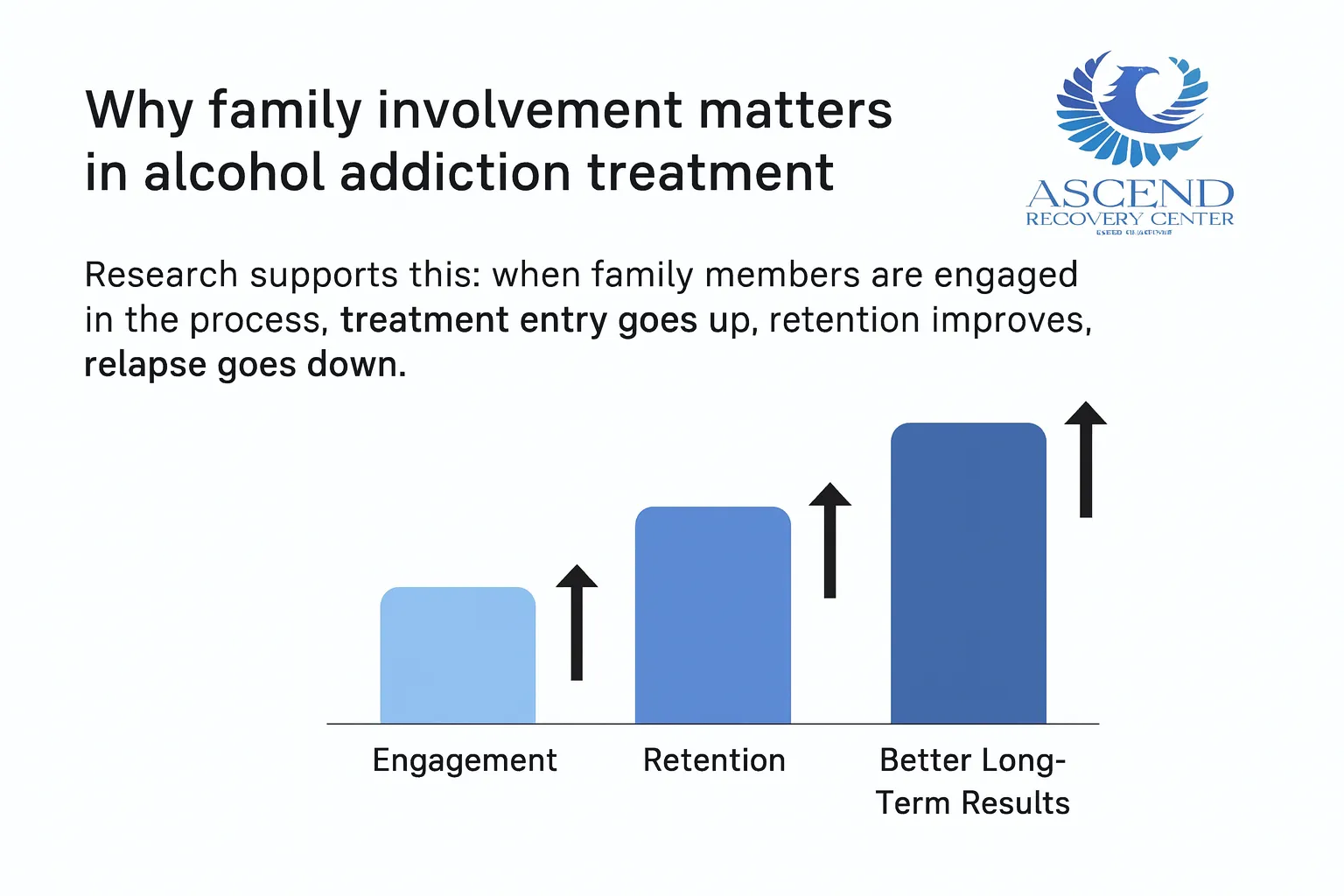
Addiction does not happen in isolation. It lives in living rooms, at kitchen tables, behind locked doors. The effects ripple across siblings, parents, relationships. Research supports this: when family members are engaged in the process, treatment entry goes up, retention improves, relapse goes down.
For you, the parent, this means your involvement is not a luxury—it’s a core part of the solution. You’re not simply watching from the sidelines. You’re part of the team.
What true involvement looks like (not drama, just steady)
Being involved doesn’t mean you have to become a therapist. It doesn’t mean you lost your role as parent. It means showing up differently.
Here are realistic actions:
- Attend one family session at the facility.
- Learn the basics of addiction: how it affects the brain, body, relationships.
- Ask your child: “How can I support you without stepping on your recovery path?”
- Change your responses at home: less suspicion, more safety; less blame, more boundary‑setting.
Simple. Hard. But more effective than shouting or withdrawing.
You won’t look perfect—and you don’t need to. You need to be present.
How your involvement improves outcomes in treatment
When the whole family shows up, treatment landings change.
- Engagement rises: People with engaged family support are more likely to follow through.
- Retention goes up: Treatment retention improves when loved ones are involved.
- Better long‑term results: Outcomes improve in sobriety, relapse prevention, family functioning.
In plain language: your presence can keep your child in the process long enough for real change to happen. And that can mean the difference between short‑lived sobriety and a durable recovery.
The metaphor: Your family is the soil, treatment is the seed
If addiction treatment is the seed, your family involvement is the soil. Even the best seed struggles in poor soil. No one imagines the plant growing without root support.
You’re the ground. Your willingness to change, to learn, to hold safe space—this nourishes recovery. Without you, that seed still tries. But with you, it can thrive.
Common pitfalls for parents—and what to do instead
Pitfall 1: Trying to fix everything by yourself
You may believe that if only you did “X,” your child would be fine. But fixing isn’t the role here. Supporting is.
Do instead: Ask what their treatment team needs from you. Listen.
Pitfall 2: Blaming yourself (“I failed as a parent”)
This spiral is understandable—but not helpful. Addiction is a disease. It isn’t caused by one moment or one decision.
Do instead: Shift your mindset. “My child has a disease and I’m learning how to respond differently.” That’s no small statement.
Pitfall 3: Withdrawing in frustration
When things go sideways again, it’s tempting to give up. To say: “I tried.” But when you walk away, recovery loses part of its foundation.
Do instead: Keep showing up. Even when you feel powerless, your presence matters. Research confirms that positive, engaged family involvement matters even after relapse.
How to rebuild trust, communication and support at home
- Start with clarity: I’m scared. I want you safe. I want us better. Honest beats trying to act okay.
- Establish boundaries: Not out of punishment—but safety. What you will and won’t do. Consistent boundaries help treatment work, more than ultimatums.
- Join their process: Ask to attend family sessions. Ask to watch learnings. Be open to adapting.
- Celebrate small wins: Sobriety isn’t always dramatic. A week, a day, a calm morning—lean in.
- Take care of yourself: You’re in the soil business here—so you need nourishment too. Parent support groups, therapy, self‑care—all count.
When your child balks at your involvement
Maybe they push back. Maybe they resist. That’s normal. Your involvement isn’t about control—it’s about consistency and care.
Explain: I’m here. I want to be part of your recovery—not leading it, just supporting it. Let them choose how. Let them see your support without coercion. Over time, that matters.
Programs that train families (like CRAFT) use positive reinforcement, not confrontation—helping loved ones engage without dramatic fights.
FAQs for parents navigating this path
Q: What if I feel like I’m the only one doing anything?
A: You’re not. Many families feel isolated. But your involvement is a huge factor in the data. You are part of the process—not separate from it.
Q: My child already dropped out of treatment once. Does family involvement still help?
A: Absolutely. Re‑engagement is common. Family support improves retention even after past attempts.
Q: Can younger siblings or grandparents be part of this?
A: Yes. “Family” means whatever circle matters—including siblings, grandparents, partners. When the people who matter show up, the effect grows.
Q: How long do I stay involved?
A: There’s no fixed timeline. Some families engage intensively for 3‑6 months; others maintain lighter involvement for years. What matters is consistent presence, not perfection.
Q: What if I don’t know what to say or do?
A: That’s okay. Ask. Learn. Many programs—including ours—have family education sessions where you can get skills, language, clarity.
The reality: You may feel powerless—but you’re not powerless
Watching your child use again is one of the hardest parental roles there is. But hope doesn’t come only when they wake up sober. It comes when you shift how you show up.
You may feel like you’ve been sidelined by addiction for years. But now you have a choice: show up differently.
You might still feel scared, exhausted, confused. And that’s okay. What matters is not the absence of fear—but what you do in spite of it.
If you’re ready to show up differently—and help your child in recovery and help your family heal together—call us.
Call (844) 628‑9997 to learn more about our alcohol addiction treatment services in Charlotte, North Carolina.