



Some people imagine recovery as hitting pause on the world—stepping away from all responsibilities to focus on healing. For many in Charlotte, that’s not realistic. You might still be closing deals on your laptop, running to class, or packing lunches for your kids while also showing up for treatment.
Attending an Intensive Outpatient Program in Charlotte, North Carolina means committing to several sessions a week, often during hours when “life” is still happening all around you. The schedule is real, the demands are constant, and you’re doing it all while working on yourself.
If you’ve felt pulled in every direction lately, it’s not a sign you’re failing—it’s proof you’re navigating something most people will never have to juggle. And yes, it can be done without burning out.
1. Treat IOP Like a Non-Negotiable Appointment
When work deadlines loom or a school project demands attention, it’s easy to tell yourself, I’ll skip just this one session. But treatment is not optional self-care—it’s essential care.
Approach your IOP schedule like you would a meeting with your company’s CEO, a final exam, or a parent-teacher conference. Those aren’t things you cancel casually, and neither is your recovery.
Communicate your schedule clearly to your employer, professors, or co-parent. You don’t need to share details you’re not comfortable with, but being upfront about your availability helps set expectations and prevent last-minute conflicts.
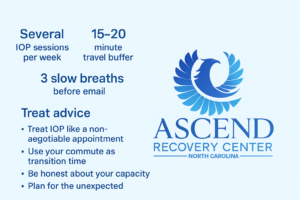
In Charlotte, where commuting times and traffic can be unpredictable, especially on I-77, factor travel into your commitment. Giving yourself a 15–20 minute buffer means you’re less likely to walk into group late and flustered.
2. Build Small Recovery Rituals Into Your Day
IOP sessions provide structure, but the real work happens in the hours between. Integrating recovery tools into your daily routines reinforces what you’re learning and helps you stay grounded when life gets noisy.
These rituals don’t have to be dramatic or time-consuming:
- Taking three slow breaths before you open your email.
- Walking outside for 10 minutes after class to reset your mind.
- Drinking water before your first cup of coffee.
- Writing down one thing you’re grateful for before bed.
Over time, these micro-habits act like anchors. They keep you steady even when the day feels chaotic.
One client once described them as “tiny bookmarks in the middle of a crowded novel”—small moments that remind you where you are and what matters.
3. Use Your Commute as Transition Time
For high-functioning people, it’s common to shift straight from one role to another—answering work emails in the car before walking into a treatment session, or grading papers while waiting in the IOP lobby.
Instead, think of your commute as an intentional transition zone. Use the time to shift your mental gears:
- Listen to a podcast about recovery or mindfulness.
- Play calming music to bring your nervous system down from the day’s stress.
- Sit in silence for a few minutes and just notice your breathing.
These moments create a separation between the outside world and your therapeutic space. They help you arrive more present, more open, and more able to engage.
4. Be Honest About Your Capacity
One of the traps for high-functioning individuals is overextending themselves to “prove” they can do it all. In IOP, this habit can quietly work against you.
If work projects are stacking up, your kids’ schedules are overwhelming, or you’re falling behind in class, say something—both to your personal circle and to your treatment team.
A skilled IOP team can help you problem-solve and find ways to protect your bandwidth. Sometimes that means adjusting your session times, setting firmer boundaries with others, or finding outside resources to lighten your load.
Remember: burnout can erode the progress you’re making in recovery, even if you’re still technically “showing up” for sessions.
5. Let Your Support System Do Their Job
Many people in your life would gladly step in to help, but they might not know what’s actually useful. If someone offers to drive the kids to soccer practice, pick up groceries, or drop off dinner—say yes.
This isn’t about weakness. It’s about building sustainability. When you accept help, you conserve energy for the work that only you can do—your healing.
If you don’t have nearby family, look into community resources in Charlotte, such as local parenting networks, rideshare groups, or time-banking exchanges where neighbors trade services.
6. Plan for the Unexpected
Life doesn’t stop because you’re in IOP. Kids get sick. A professor extends a project deadline—right into your session time. Charlotte traffic can derail your whole evening.
Have backup plans for childcare, transportation, and work coverage. Keep the phone numbers of your go-to helpers saved and easily accessible.
Your goal isn’t to control every variable—it’s to make sure one unexpected event doesn’t unravel your whole treatment week.
7. Remember the Hidden Cost of Pushing Through
High-functioning people often excel at pushing through exhaustion. But there’s a hidden cost: the slow erosion of your emotional reserves.
Recovery isn’t just about not using. It’s also about building a life you don’t have to escape from. If every week is a survival sprint, you may technically stay sober, but you won’t feel well.
Give yourself permission to have quieter evenings. Cancel a non-essential commitment. Let the laundry sit for a night. Your healing isn’t a luxury—it’s the foundation for everything else.
The Bottom Line
Balancing IOP with work, school, or parenting isn’t about doing everything perfectly—it’s about protecting the non-negotiable space for your recovery while adjusting the rest of life around it.
You may feel like you’re holding a dozen spinning plates at once, but the truth is, IOP can make those plates lighter over time. The skills you’re learning will help you not only stay in recovery, but also navigate the demands of a full, complicated life with more clarity and peace.
Call (844) 628-9997 to learn more about our IOP services in Charlotte, North Carolina.
Frequently Asked Questions About Balancing IOP With Daily Life
How many hours per week does an Intensive Outpatient Program take?
Most IOPs meet 3–5 days a week for 3 hours per session. At Ascend North Carolina, sessions are designed to fit into mornings or evenings so you can still manage work, school, or family responsibilities.
Can I work full-time while in IOP?
Yes, many clients do. It requires clear scheduling, honest communication with your employer, and strong boundaries around your treatment time. Your IOP team can help you troubleshoot conflicts.
What if I have to miss a session?
Life happens. If you need to miss due to illness, childcare, or a genuine emergency, communicate with your treatment team immediately. Many programs offer make-up sessions or alternative arrangements.
How do I explain my IOP schedule to my boss or professors without oversharing?
You can say you have ongoing health appointments or a standing medical treatment schedule. You’re not required to disclose details unless you choose to.
Will I still have time for my kids or personal life?
Yes—though your schedule will be busier during IOP. Many clients find that their time with family becomes more intentional and present, even if it’s shorter, because they’re working on their own wellness.
What if I start to feel overwhelmed?
Tell your IOP team immediately. Overwhelm is not a failure—it’s a sign that adjustments are needed. Support is part of the process, not an afterthought.