


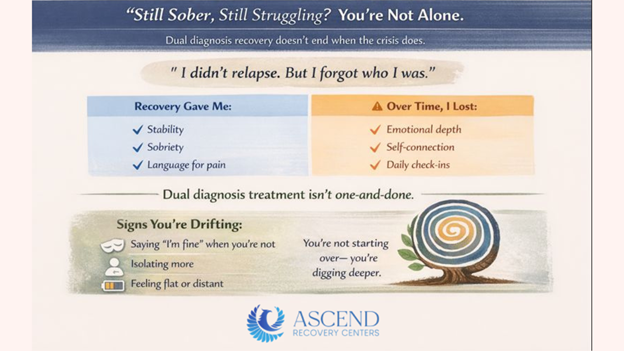
I didn’t crash. I didn’t relapse. But one day, I looked in the mirror and didn’t recognize who was staring back. Not in a dramatic way—just a dull, subtle kind of fading. I was still sober. Still functioning. But I wasn’t really here.
That’s the part no one talks about after recovery: how easy it is to vanish from yourself again. Even without using.
Ascend’s dual diagnosis treatment was the first place I ever felt truly seen. It gave me words for things I didn’t even know I was carrying. But somewhere along the line, I stopped listening to those parts of me. And they got quiet.
Getting Clean Didn’t Mean I Knew How to Stay Connected
When I first got into treatment, everything hurt—loudly. The chaos, the shame, the spiraling mental health symptoms. But it also made everything feel real. I felt things. I showed up for things. I was cracked open and honest.
Fast-forward a few years, and that intensity faded. Life got stable. I got jobs, insurance, better sleep. But I also got numb. I started saying “I’m good” when I wasn’t, because I thought being okay meant I shouldn’t still need help.
Turns out, dual diagnosis doesn’t stop being relevant just because the crisis ends. Mental health isn’t something you check off like a step on a to-do list.
I Didn’t Relapse. But I Was Drifting.
Here’s the thing: drifting is dangerous in its own quiet way. You stop checking in with yourself. You stop feeling much of anything at all. I wasn’t using, but I was slipping into avoidance—scrolling more, isolating, letting old wounds settle in like background noise.
Dual diagnosis recovery taught me that mental health and addiction recovery are woven together. When I forgot to tend one, the other started pulling at threads.
Your Mental Health Deserves Maintenance, Not Just Crisis Response
Nobody clapped for me when I told my therapist I felt disconnected. There was no cake for that milestone. But that conversation may have saved me from a slow, silent unraveling.
If you’ve been out of treatment for a while and you’re wondering why nothing feels wrong but everything feels off—trust that feeling. It doesn’t mean you’re broken. It means you’re ready for the next layer of healing.
Recovery Isn’t Just About What You Quit
Recovery is about who you become—and keep becoming. For me, that meant going back to some of the tools I thought I’d outgrown: group check-ins, dual diagnosis support, even journaling. Not because I was back at square one, but because I wanted to be present again.
I needed a space where I didn’t have to pretend everything was fine just because I wasn’t using. A space like Ascend.
Dual Diagnosis Treatment Isn’t One-and-Done
If you’ve been in recovery for years, it’s easy to think that asking for help now is some kind of regression. It’s not. It’s growth.
Places like Ascend North Carolina understand that dual diagnosis treatment is about layers. Some you peel back in crisis. Others you only get to when you’re strong enough to sit with the quiet.
You’re Not Broken. You Might Just Be Bored of Yourself.
That’s what hit me one night—I wasn’t spiraling. I was just… bored. Emotionally beige. Like I’d outpaced my own sense of self.
Dual diagnosis support helped me remember that mental health isn’t a side quest. It’s part of the main story. And I still get to grow, deepen, evolve. You do too.
If you’ve been sober a while but feel stuck, disconnected, or just “off,” that’s not a failure. It’s an invitation. Ascend’s dual diagnosis treatment can help you reconnect—not just with your recovery, but with yourself.
📞 Ready to feel like you again? Call (844) 628-9997 or visit Ascend’s Dual Diagnosis page to learn more about our Dual diagnosis treatment services in North Carolina.