


The end of the year can stir up more than just holiday stress. For some, it brings a quiet truth to the surface: Something has to shift.
Maybe you’ve been carrying anxiety that never quite leaves. Maybe the “one drink to unwind” has turned into three… or more. Maybe therapy helped for a while, but something’s still stuck. Maybe you’re not falling apart, but you’re also not feeling whole.
And maybe—just maybe—you’re ready to ask a new question: What if it’s not just one thing?
At Ascend North Carolina, our dual diagnosis treatment program helps people like you get unstuck. We offer care that sees both your mental health and substance use—not in isolation, but together. And if you’re thinking of starting before the New Year, or planning for January, this guide is here to answer the questions you’re probably already asking.
What is dual diagnosis treatment?
Dual diagnosis treatment is care designed for people living with both a mental health condition (like depression, anxiety, PTSD, or bipolar disorder) and a substance use issue (like alcohol or drug misuse).
The name sounds clinical, but the experience it describes is deeply human: when emotional pain and substance use start to tangle—and traditional, one-track treatment plans don’t quite fit.
Instead of treating “one thing at a time,” dual diagnosis treatment addresses the full picture. At Ascend, that means:
- Mental health therapy and addiction counseling
- A team that works together, not separately
- Medication support that considers your whole story
- A plan designed for you, not a label
You don’t have to choose which part of you gets help first. We support all of you at once.
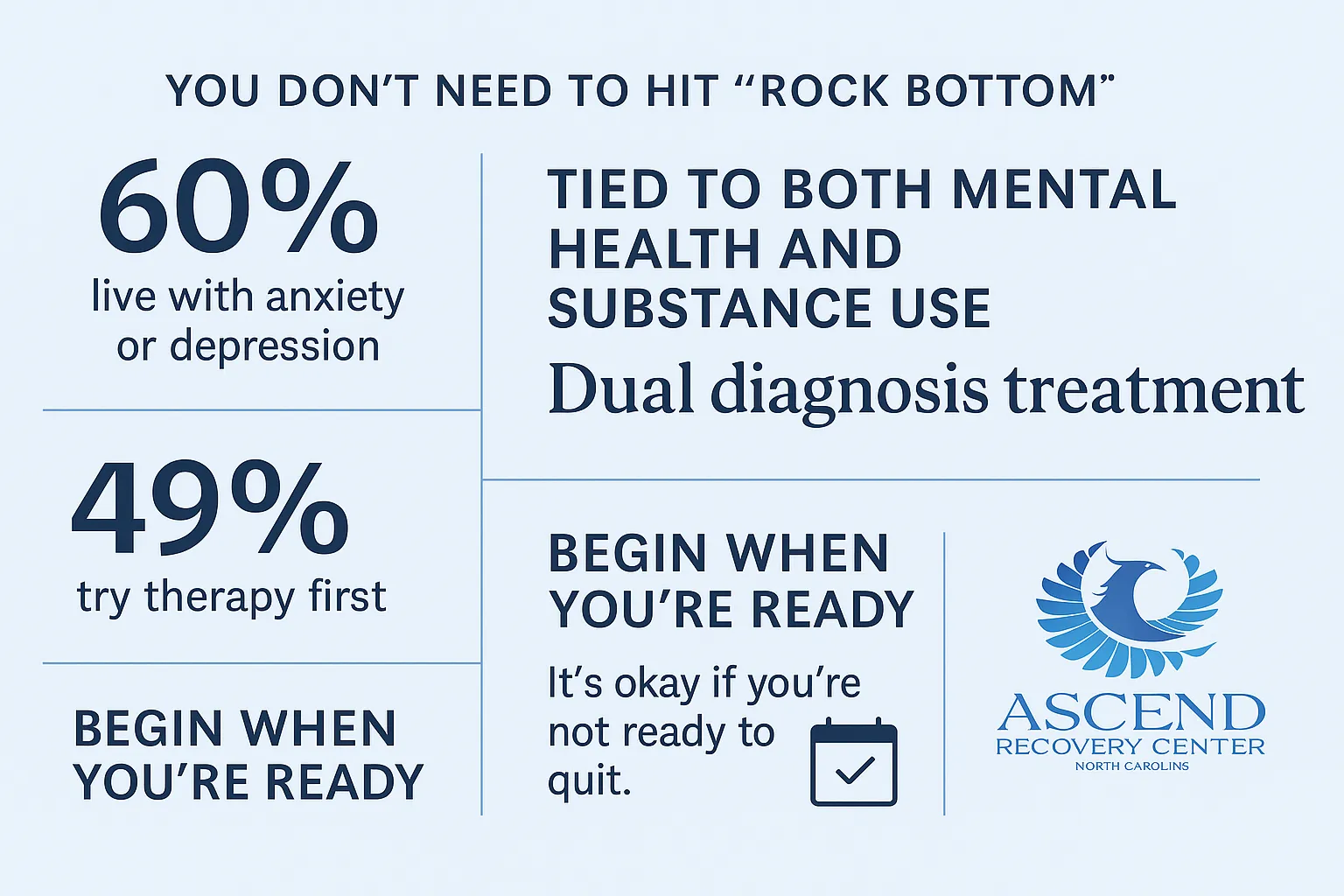
Do I need to hit “rock bottom” to get help?
No. And we can’t say this clearly enough: you do not need to crash to deserve care.
Many of our clients are high-functioning. They’re showing up at work, taking care of others, and holding things together on the outside. But inside? It’s shaky. Exhausting. Disconnected.
Dual diagnosis treatment isn’t just for people in crisis. It’s for anyone who’s tired of the silent tug-of-war between how they feel and how they cope. If you’ve ever thought, I’m not fine, but I’m not falling apart either, you’re in the right place.
How do I know if I actually need dual diagnosis care?
If you’re sober curious—or maybe just therapy-curious—but you feel like your emotional health and substance use are tied together, this might be a good fit.
Here are a few signs that dual diagnosis treatment could help:
- You drink or use to manage stress, sleep, or social anxiety
- Therapy helped… but it didn’t feel like enough
- You’ve tried cutting back, but it’s harder than you expected
- Your mood shifts more dramatically when you’re using (or withdrawing)
- You feel stuck in patterns you can’t talk about in either a mental health or addiction setting
Still not sure? That’s okay. Part of our job is helping you sort through what’s going on—even if you don’t have the words for it yet.
Is this different from regular therapy or addiction treatment?
Yes. And it’s different on purpose.
Most traditional therapy is built to treat mental health—but may not be equipped to address substance use. Most addiction programs focus on sobriety—but may not go deep into trauma, anxiety, or mood disorders.
Dual diagnosis treatment bridges that gap.
Here’s what that means at Ascend:
- Clinicians trained in co-occurring disorders
- No need to “hide” one issue to focus on the other
- Support that treats symptoms and their source
- Less fragmentation. More clarity. More wholeness.
What if I’m not ready to quit completely?
That’s okay. Really.
You don’t have to have it all figured out before you start. Many of our clients begin dual diagnosis treatment unsure about what they want to change—or how fast. That’s not resistance. That’s honesty.
We’ll work with you to define what “better” looks like, and at what pace. Some people want full abstinence. Some are exploring reduction. Some just want to feel something other than this.
No pressure. No judgment. Just support, one step at a time.
Can I start before the holidays—or wait until January?
Yes, and yes.
Some people feel a strong pull to begin treatment before the new year. Others want to make a clear, intentional plan to start in January. Both paths are valid.
If you’re ready to begin now, our admissions team can help with a quick, respectful intake process so you’re supported through the holiday season.
If you’d prefer to wait until after the new year, we can schedule a pre-admission consult and get everything in motion—so you can begin 2025 with a plan that supports the version of yourself you’re ready to reclaim.
What does dual diagnosis treatment actually look like?
At Ascend Recovery Center in Charlotte, North Carolina, dual diagnosis treatment is customized to your needs—but here’s a general picture of what it can include:
1. Comprehensive Assessment
We don’t rush to label. We take time to understand your mental health, substance use history, physical wellbeing, and emotional goals.
2. Integrated Therapy
You’ll work with therapists trained in both addiction and mental health. We offer evidence-based treatments like CBT, EMDR, and trauma-informed care.
3. Medication Management (If Needed)
If medication is part of your care, our team ensures it supports both your mental health and recovery goals—never one at the expense of the other.
4. Group Support
Small groups offer space to connect with others navigating similar challenges—without pressure to define yourself by any one label.
5. Outpatient Flexibility
Our outpatient program allows you to receive consistent care while keeping up with work, family, or other life responsibilities. We also offer virtual therapy when appropriate.
Is dual diagnosis care private?
Yes. Everything you share is protected by HIPAA laws and confidentiality policies. We know how important discretion is—especially if you’re a working professional, caregiver, or someone in the public eye.
We’ll never share your information or progress without your explicit permission.
What does it cost—and does insurance cover it?
Costs vary based on your level of care, but many insurance plans do cover dual diagnosis treatment. Our admissions team can verify your benefits and walk you through your options—clearly and without pressure.
We also offer private pay options and will help you understand all costs upfront, so there are no surprises.
If you’re asking the questions, you’re already taking the first step.
Call (844) 628-9997 or visit our dual diagnosis treatment page to explore what’s possible when you stop choosing between mental health and recovery—and start healing both.